Orthodontic treatment for older adults is far more common than most people assume. If you have been thinking you missed your window to straighten your teeth, you almost certainly have not. This is a look at what treatment actually involves in your fifties, sixties and beyond, from gum health and existing dental work through to realistic timelines and retainers. If you want the broader picture first, our adult orthodontics page covers the options for patients of every age.
What Is Orthodontic Treatment After 50?
Orthodontic treatment after 50 is a real, safe option: teeth can move at any age because the bone around your roots remodels throughout life, not just during childhood. Adults in their fifties, sixties, and beyond straighten teeth with aligners or braces, often to protect long-term oral health.
Adults now make up a growing share of orthodontic patients across the country, and that includes plenty of people right here in Holly Springs.
Most older adults come in with one of these goals:
- Crowding that has gotten worse over the years
- Teeth that have shifted after a lifetime of chewing and clenching
- A bite that has collapsed following tooth loss or heavy wear
- Gaps and spacing that trap food
- Alignment before a crown, bridge, or implant is placed
So how is this different from treating a teenager? Three ways. You likely have existing fillings, crowns, or bridges to work around. Your gum and bone history matters more. And there’s no jaw growth to work with, so every change comes from careful tooth movement.
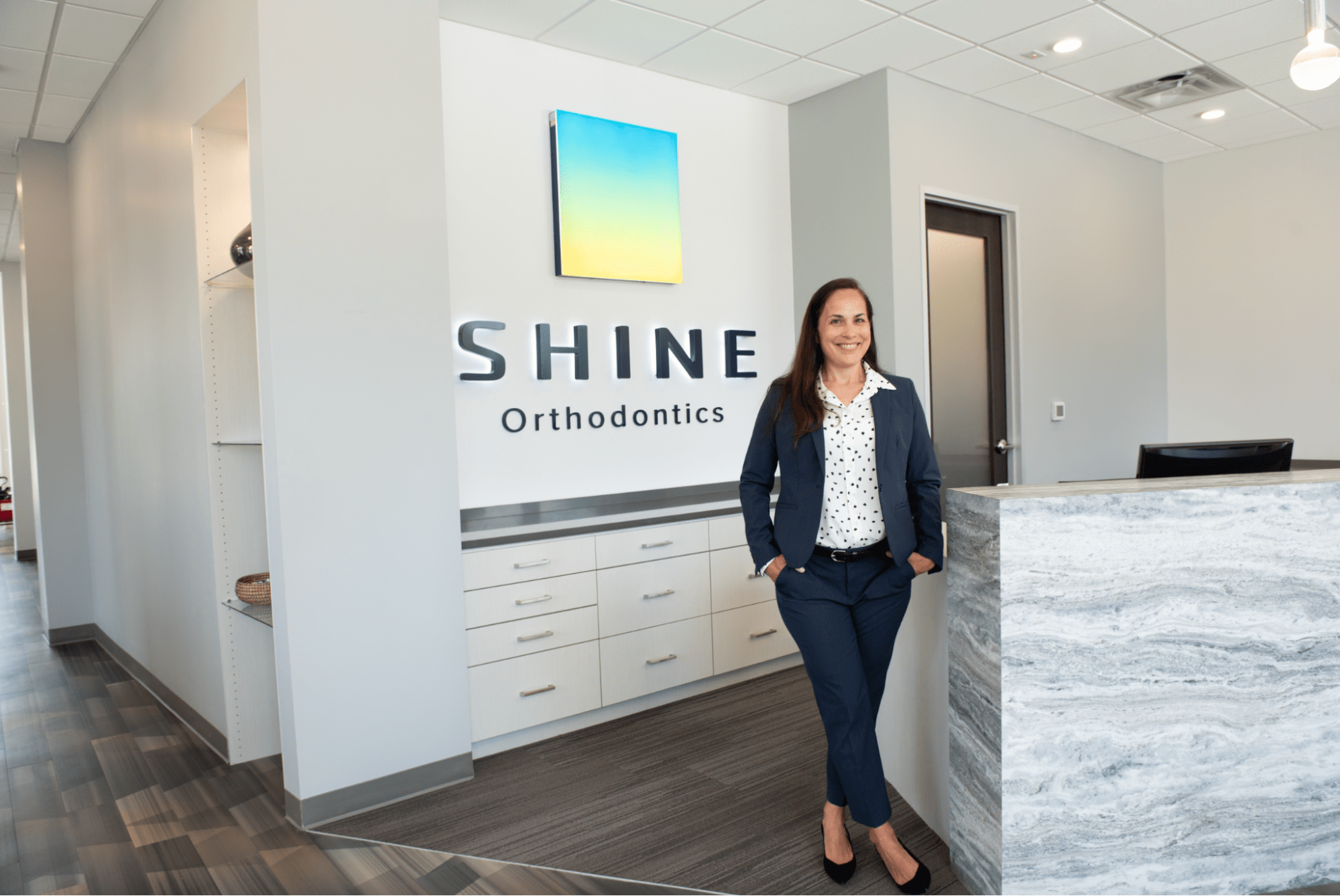
That’s why Dr. Rita McGrogan coordinates closely with your general dentist, and with a periodontist when gum support needs attention first. Treatment at Shine Orthodontics is planned around the mouth you have today, not a textbook case.
How Orthodontic Treatment Works for Adults Over 50
Treatment for older adults follows five steps: diagnostic records, a health check of your gums and existing restorations, a personalized plan using aligners or braces, gentle tooth movement with lighter forces, and retainers afterward. Minor cases can finish in about 6 months. Complex bites may take 24 months or longer.
Here’s what each step looks like.
1. Your free consult and records. Dr. McGrogan reviews your smile, takes photos, and captures X-rays or a digital scan of your teeth and gums. The scan takes a few minutes and gives a highly accurate 3D view of your bite.
2. A health check before anything moves. Gum health and bone support come first. Active gum inflammation, deep pockets, or a loose crown all get addressed before tooth movement begins, which protects your investment.
3. Your personalized plan. Based on your records and goals, you’ve got options: Invisalign clear aligners, clear braces, or metal braces. Dr. McGrogan walks you through what each one would mean for your specific case, including timeline.
4. Gentle, measured movement. Grown-up bone is denser and less springy than it was in your teens, so lighter forces and a slower pace protect your roots and the bone around them. Modern wires apply continuous, low-level pressure rather than heavy tightening.
5. Progress visits, then retainers. You’ll come in every 4 to 8 weeks depending on your appliance, and virtual check-ins are available for some visits. Once your teeth are where they belong, retainers hold them there. For adults, retainer wear is a long-term habit, not a temporary one.
Timelines vary widely. Closing a small gap is not the same as correcting a collapsed bite, and Dr. McGrogan gives you a realistic range at your first visit.
Benefits of Straightening Teeth After 50
Straight teeth do more than look good. At this stage of life, the health payoff is often the bigger motivator, and it’s a big part of why Dr. McGrogan sees so many adults start treatment in their fifties and sixties.
- Easier cleaning. Straight, well-spaced teeth are simpler to brush and floss, which lowers plaque buildup, decay risk, and gum inflammation. Plaque is a sticky, colorless film of bacteria, food, and saliva, and crowded teeth give it more places to hide.
- Better bite distribution. When your teeth meet evenly, chewing forces spread out. That means less uneven wear, fewer chips, and less strain on your jaw joints and muscles.
- A stronger foundation for restorative work. Crowns, bridges, and implants last longer and fit better when the teeth around them are properly aligned. Many dentists refer adults for alignment before placing an implant for exactly this reason.
- Improved chewing and speech comfort. A functional bite makes eating easier and can smooth out speech issues caused by spacing or an open bite.
- Confidence that shows up everywhere. Plenty of the adults we treat at Shine Orthodontics have been self-conscious about their teeth for decades. Fixing that changes how you present yourself at work, at weddings, in photos with grandkids.
- Prevention. Teeth that keep drifting put uneven pressure on the bone that supports them. Addressing shifting now can help you keep teeth you might otherwise lose later.
A healthy and confident smile matters at every stage, and it is never too late to start orthodontic treatment.
Invisalign vs. Clear Braces vs. Metal Braces After 50
All three work for adults over 50. The right choice depends on your case complexity, your existing dental restorations, and how visible you’re willing to let treatment be.
Invisalign
These removable aligners are almost invisible and can give you stunning before & afters. They come out for meals and cleaning, which makes them the easiest option if you have crowns, bridges, or implants to work around. The catch is discipline. You need to wear them 20 to 22 hours a day for them to do their job.
Clear Braces
Clear braces blend in with your teeth, so they’re less noticeable than metal braces. Paired with clear, white, or tooth-colored wires and elastic ties, they’re a low-profile fixed option that handles moderate to complex movement well. Nothing to remember to put back in.
Metal Braces
Today’s metal braces are more comfortable, less visible, and lighter than ever before. For complex bite correction, they remain the most efficient tool available, and they ask the least of you day to day. You brush, you show up, the braces do the work.
Existing restorations matter here. Brackets don’t bond to porcelain the same way they bond to enamel, and implants don’t move. Dr. McGrogan factors all of that into the recommendation, which is why the plan you get is built around your mouth specifically. Our guide to adult orthodontic treatment options walks through the same three choices for adults at any age.
For many adults weighing braces or Invisalign over 50, the deciding factor comes down to daily habits and how much they’d rather not think about their teeth. Many of our adult patients choose aligners simply for discretion. If you spend your days in meetings or in front of clients, that matters.
What Shapes Your Treatment Plan After 50
Every plan looks a little different, and the differences come from your mouth rather than your age. These are the things that shape how involved treatment ends up being.
- Amount of movement needed. Closing one gap is a much shorter project than correcting a collapsed bite.
- Number of arches treated. Some cases only need the upper or lower arch. Others need both.
- Appliance type. Aligners, clear braces and metal braces each run on their own timeline and visit schedule.
- Refinements. Some cases need a second set of aligners or extra adjustments to finish precisely.
- Supporting care. Periodontal treatment or a new crown may be needed before or after alignment.
- Retainers. Holding the result is part of the plan from the start, not an afterthought.
Many adult dental plans include an orthodontic benefit, even at 50 and beyond, so it is worth reading your policy or calling your carrier. Our team can check your coverage for you, and you can see what we work with on our insurance and finances page.
The only way to know exactly what your case involves is a diagnostic exam. Once Dr. McGrogan has your records, she lays out the full plan with no guessing.
Are You a Candidate for Braces or Invisalign Over 50?
You’re likely a candidate for braces or Invisalign over 50 if your gums are healthy, you have adequate bone support around your teeth, and your existing crowns and fillings are stable. Age itself is not a disqualifier. Active gum disease is, at least until it’s treated and brought under control.
Good signs you’re ready:
- Healthy gums with no active infection or bleeding
- Enough bone support to anchor tooth movement safely
- Stable restorations that aren’t loose or failing
- A willingness to keep up with brushing, flossing, and visits
- Readiness to wear retainers long-term
Things that need planning, not a “no”:
- Missing teeth. Gaps can often be closed or prepared for an implant.
- Implants. They won’t move, but teeth around them can be aligned to them.
- Partial dentures. Treatment can still work, with coordination on timing.
- Gum recession or past bone loss. Manageable with lighter forces and close monitoring.
- Medications affecting bone density, or conditions like diabetes. These call for coordinated planning with your physician and dentist, not automatic disqualification.
What matters most isn’t your age. It’s your oral health and your commitment to the process.
Curious where you stand? A free consult at Shine Orthodontics gives you a clear answer, along with a look at your options and what orthodontic treatment for older adults would realistically involve, with no obligation attached. Dr. Rita McGrogan, DMD, MS, completed four years of college, four years of dental school, and a three-year orthodontics residency, 11 years of training in total. That residency is what makes her an orthodontic specialist rather than a general dentist. Adults over 50 come in regularly, and our office welcomes patients of all ages.
Schedule your free smile exam and let’s talk about your options. We’re here to make you smile.
Frequently Asked Questions About Orthodontics After 50
Am I too old for braces?
No. There is no upper age limit for orthodontic treatment as long as your oral health supports it. Teeth move because bone remodels around the roots, and that happens throughout your life. Dr. McGrogan treats patients of all ages, and adults over 50 are a regular part of the practice.
Does treatment take longer for older adults?
Often somewhat longer, yes. Adult bone is denser than a teenager’s, so teeth typically move at a more measured pace. Dr. McGrogan also uses lighter forces on purpose to protect your roots and bone. Your specific timeline depends far more on case complexity than on your birth year.
Can I get Invisalign with crowns, bridges, or implants?
Usually, yes. Aligners are often the preferred choice when you have existing restorations, since they don’t require bonding brackets to porcelain. Implants can’t be moved, but the surrounding teeth can be aligned around them. Bridges connect multiple teeth, which limits independent movement in that section, so the plan gets adjusted accordingly.
Is treatment safe with gum recession or bone loss?
Yes, when the condition is stabilized first and monitored throughout. Tooth movement doesn’t cause gum disease, but moving teeth in an actively inflamed mouth can worsen bone loss. That’s why Dr. McGrogan requires healthy gums before starting and coordinates with your dentist or periodontist during treatment.
Will my teeth shift back?
They will try to, which is why retainers are required indefinitely. Teeth have a natural tendency to drift throughout life, and that’s true whether or not you’ve had braces. Wearing your retainer as directed is what keeps your results looking the way they did on day one.
Do braces feel worse after 50?
No. Soreness after a bracket is placed or a wire is adjusted is mild and temporary, much like it is for younger patients. Expect some tenderness for a day or two. Soft foods and a warm salt water rinse handle it well.